A NOTE ABOUT THIS EPISODE
I recorded this as NaNoWriMo 2022 was starting. NaNoWriMo shut down in 2025, and the details about my course beta, my audiobook and release date, and my trip to a conference that month are out of date, and so is the plug for the transcript download. The three habits still work for any writing sprint.
SUMMARY
I recorded this on the first day of NaNoWriMo while I was 10K into a book that was already scheduled to release at the end of the year, with a week away from my desk planned in the middle of the month. I could have panicked. Instead I put on my millionaire author hat: treat the deadline as something you can do, and don't hand yourself excuses. I walk through three habits that make that practical.
The first is to set your intention before you start. Mine was to hit 50,000 words, but I knew I'd write nothing during my week away, so I gave myself permission to take it off. I planned about 2,000 words a day for the other three weeks and considered an extra week in December if I fell short. Then I say to hold that decision as your dominant intent, even when days get tough.
The second is to focus solely on what's important. For me that meant my book came ahead of social media and possibly a podcast episode that week, and I explain how Parkinson's Law helps when the deadline is the month itself. The third is to delegate the rest: dinners, chores, errands, and anything you don't personally have to handle.
I also share a trick for nights when you're tired and don't feel like writing: give yourself ten minutes and see what happens. I say nine times out of ten you keep going.
WHAT YOU'LL LEARN
- How to set an intention before you start, including how to plan around a week you can't write
- How to decide what matters most during a writing push and let the rest slide
- What you can delegate to family, a partner, an assistant, or a hired helper to get writing time back
- The ten-minute trick for nights when you're tired and don't want to write
- Why I say the messy middle is normal, and why I keep going through it
UPDATE FOR 2026
NaNoWriMo shut down in 2025, but setting an intention, protecting your writing time, and handing off the rest work for any writing sprint, including the six-week writing sprint. If you're looking for what to do instead of NaNoWriMo, I put my ideas in this post.
KEEP LISTENING AND READING
- What are the best NaNoWriMo alternatives?
- What are 5 tips for taking on NaNoWriMo?
- Can ChatGPT be your writing accountability partner?
- Balancing Writing and Well-Being During NaNoWriMo
- What's a Better Alternative to NaNoWriMo? The Six-Week Writing Sprint
WANT THE FULL PLAN?
Rapid Release Roadmap walks you through the six-week sprint and a pace of about four books a year. You set the pace. If you'd like everything I teach, the Library Pass opens all 23 masterclasses for a one-time $97.
FREQUENTLY ASKED QUESTIONS
How do you stay productive during NaNoWriMo?
I share three habits: set your intentions first, focus solely on what's important, and delegate the rest. I describe them as the productivity hacks a millionaire author uses to take on NaNoWriMo.
What does it mean to set your intention for NaNoWriMo?
I say it means deciding up front what you're going to do and then holding it as your dominant intent through the month. My intention was to hit my 50,000-word goal, and I say you can remind yourself of it in small bits throughout the day so it stays important when you reach your writing time.
What if I know I can't write for part of the month?
I planned around it. I knew I'd be away for a week, so I gave myself permission to take that week off, wrote 10,000 words beforehand, and planned to write about 2,000 words a day on the other days. I say I might use an extra week in December, depending on how things go, and that I'm okay if I don't reach the full 50,000.
What should I focus on during NaNoWriMo, and what can I let slide?
I say to focus on what's most important while you're writing, and that for me the book comes ahead of social media engagement. I also say I might skip a podcast episode that week, since producing one takes about a day. I say I use Parkinson's Law, that work expands or contracts to fit the time you give it, and I add that I don't mean ignoring your family. It means working with them so they understand this is important to you for a month.
What can I delegate during NaNoWriMo?
Anything you don't personally have to handle. I mention your kids, your spouse, or a personal assistant, and chores like cooking, cleaning, vacuuming, mowing the lawn, or raking leaves. I suggest explaining to your family why this matters, hiring someone, asking a friend, or bringing in snack foods or prepping meals in advance.
How long does it take to write 2,000 words?
I say that when I'm focused, I can write 2,000 words in about two hours.
What if I'm too tired to write at night?
I suggest telling yourself you'll try for ten minutes, and if you really don't want to continue after that, you can close your laptop and go to bed. I say these are tricks I've used over and over when a deadline is looming, and that nine times out of ten you keep going once you get into your story.
How do I get through the messy middle of a draft?
I say those days will happen, when you wonder whether you know what you're doing or whether the story is any good. My answer is that it will come together in the end, that you can't edit a blank page, and that holding your intention as your dominant intent is the most powerful thing you can do.
What do you mean by a millionaire author?
In this episode I use the term for someone who takes on a challenge like NaNoWriMo, or a release deadline, without deciding it can't be done and without making excuses. I say they know they've done this before, so their clarity is stronger. I also say we all still make excuses, but we know how to work around them.
Read the full transcript
Edited for readability. Passages from the original recording that are out of date have been left out and are marked in brackets.
The indie author revolution has been around for more than a decade, but we indies continue to push the boundaries of what we're capable of, from getting over initial prejudices to staring down perfectionism and author imposter syndrome. We've become a force to reckon with. Indie authors now wear more hats than ever. As we strive to create a career full of meaning, prosperity, and potential.
We've juggled the demands and continue to be rebels in the face of adversity. Now, after years of hearing the shouts of hustle and grind, we indies are rebelling again. Gone are the days of publishing a book a month until we drop. And in its place are the seeds of a better way to rapid release, a way that feels incredible as we build a sustainable, lifelong author career that not only increases our visibility and royalties, but it's all done with intention and ease.
If you're ready to buck the system and become the visionary author I know you're meant to be. You've come to the right place. I'm Carissa Andrews, international bestselling indie author, and this is the Author Revolution podcast. Well, hey there, and welcome back to the Author Revolution Podcast.
Here we are. It's here. It's finally here. Yes.
That's right. NaNoWriMo is upon us. Are you ready? Have you figured everything out and gotten your plan in place, and gotten all of your fun projects set aside so that you can do the one thing that really matters?
Write your novel. Well, my friend, I am happy to say that that is indeed what I have gone ahead and done. I have gotten rid of all of the other projects that are on my plate, or were on my plate, I guess I should say.
[Out-of-date promotional section from the original recording removed.]
I've also finished up Immortals, the audiobook for Immortals.
It's done. It's in like distribution process. And now I can just focus on Ruins. Thank the Lord because this book is coming out December 26th.
So let's talk a little bit about what this looks like then. So I have a book. It's already scheduled to come out at the end of the year. I am 10K into the book so far, which is five chapters, and I know that there are 30 scheduled, 30 planned in this outline, right?
I could be freaking out right now. I could be going, oh my gosh, there's not enough time. Like it's coming out in two months. This is just going to like, ruin me.
I'm going to Vegas. All these things, right? I could be freaking out. Instead, I'm putting on my millionaire author hat and I'm walking through this thing knowing I've got this.
Now, let me explain why. The millionaire author. We're going to merge our two worlds here today. The millionaire author, when they take on a challenge like NaNoWriMo and they know that something is coming, like the deadline for it to be released on Amazon or whatever.
They don't look at it as if it can't be done. They don't make excuses for why this is going to be such a hard thing to do, right? They're going to go forward knowing that they've got this. They're going to go forward knowing that they've done this before.
They know how this works. And so therefore, the clarity that they have within them is that much stronger. So if this is the first time you've done Nano, or if this is the 15th time you've done Nano and you still are struggling with it, let's talk about three hacks. The millionaire author uses their productivity hacks, so to speak, for NaNoWriMo.
Okay, let's do it. Let's merge these two worlds. Hack number one is that they set their intentions first. Now, when I go into NaNoWriMo, my intention obviously is to hit my entire wordcount goal.
It's to get the 50,000 words written during this month. And now for me, I'm going to be gone for an entire week of this. I'm going to be in Vegas. We're going to be doing the whole 20Books thing.
It's going to be amazing and incredible and crazy, but it's also going to mean no words. Get on the page. I am literally giving myself permission to take that week off. So what does that look like for me then?
Does that mean I allow myself an extra week in December to go ahead and write? Perhaps depends on how things go? Or does that mean I try to spread out how much I'm writing each day, knowing that that week is not going to be covered? My intention, as I look at this, as I know what I'm trying to accomplish, is that I'm going to be writing every single day other than the week, write every single day other than the week of 20Books.
So because I've already set myself up a little bit writing 10,000 words beforehand, I feel very secure in knowing that even if I don't write on, say, Tuesdays throughout the rest of this month and I take that week off, I can pretty much eke out almost all of the words. So I'm just going to go forward. I'm just going to move every single day writing 2,000 words, getting my chapter in on those six days with the exception of the one week, and just see where I fall at the end of the month. If it's not the extra 50,000 words that I was intending to do, at least I know that first week in December.
It's only going to be a few, right? My goal my job is to get as many of these days as many of these words written as humanly possible, and I'm okay with that. I'm okay writing six days a week. I'm okay knowing that for three weeks I'm going to be writing pretty much 2,000 words every single day.
And that keeps me motivated. It keeps me focused. It helps me to keep going when days get a little tough, knowing that it's like, Carissa, it's three weeks, you know, suck it up, buttercup. It's three weeks and I've got everything planned.
I know what I'm doing in this story. It's going to be an incredible ride, and so it's going to be fun to hop into it. And that's what I'm holding on to. I'm holding on to the excitement I have for this story, the excitement I have for getting it done, the excitement I have for getting it released on time, knowing it's done, knowing it's mine.
My decision is locked in place. I know there is no other option. Period. Right?
That's how the millionaire author really makes sure that they are manifesting what their outcome will be. Okay, so then hack number two, they focus solely on what's important. Now there's a lot of things that could be coming at you all the time during NaNoWriMo. It's like an entire month, right?
So we've got Thanksgiving in the middle of that. We've talked about that in other podcast episodes before. We've got Vegas for me going on in the middle of this, I need to focus on what's most important during the time that I'm writing. And so that might mean during the Week of Vegas.
I don't give you a podcast episode. Now, I haven't decided whether or not that's going to be the case. If I am able to do two podcast episodes next week, maybe it'll happen, and if it doesn't, then I will give you an extra long one, filling you in on all the stuff that happens at 20Books Vegas, how I'd felt for me, what things were going on, what I experienced, and what I think other authors will experience and why you should go, or maybe why you shouldn't go. I don't know, I have a feeling it's why you should go, because there's way too much information coming at you at 20Books Vegas.
So we'll see. What happens. Is the podcast episode during that week the most important thing or is it getting my book done? Well, honestly guys, I love you, I really do, and I've only missed one podcast episode since I began in 2019.
But Vegas might be an exception to the rule, and I have to allow myself the grace to go. You know what? That's totally okay. That's okay.
If my writing has to take precedent, it has to take priority over the podcast episode for that week. Because let's face it, guys, this takes time. Putting together a podcast episode for you, mastering it, getting everything done so that it goes out into the social medias and on the newsletter and all the things. Right.
There's a lot of stuff that goes on behind the scenes. It takes pretty much an entire day of work, and if I need to get my writing in and I can take that day off, well, when I say day off, I'm meaning the extra day I would have to do next week. Then that means I can still get my words in for the day. So I think I've just convinced myself there's a very good chance you're not going to have a podcast episode during the week I am in Vegas.
But that being said, there's so many things that we as authors get hung up on, right? We think things are very important and really, honestly, they're not. So during Nano, is social media engagement really that important? Honestly, I personally don't believe so.
Like, I think the creation of the product is more important than putting out a social media post or engaging on TikTok or, you know, whatever, whatever. The thing is, my book, when it's trying to come out during this like focused time frame, it becomes the sole entity in my brain. It becomes the thing that expands the most so that I can get it done, and I can focus on it without kind of having that whole, like, cats in a room syndrome, you know, where, like, you can't herd the cats, they just do whatever the hell they want to do. My brain will do that if I have too many things I'm focusing on.
So instead I allow it to expand. I allow it to become the thing I want it to be. And I use Parkinson's Law to my advantage. Work expands or contracts to fit the time allotted for it.
And so if my time frame is literally this month, this is all I got. This is when Ruins is coming out. My brain will work with that. I can do that, and I have no problem letting the rest of the stuff slide until then.
So that hack number two focusing on what's most important that could mean, you know what? If you usually are being the only person to cook dinners, for instance, maybe rely on your partner, or have your teenage kids start cooking dinners or do something else. Bring in some snack foods or prep your meals in advance. Or, you know, there's all sorts of ways that you can focus on things in a different way so that you can give yourself time back.
Make sure that you're putting your writing your story first to a degree, so that it expands in your mind. It becomes something that you can really put your effort under. Yeah. So focus on what's most important.
Decide for yourself what that looks like, how it's going to play for you, and if your book is important when you're trying to get this, you know, 50,000 words out this month. Make it so. Make it be the thing that is almost for the month consuming everything. Now, I don't mean ignoring your family.
Obviously. I don't mean ignoring your kids, but I do mean working with them so that they understand that this is important to you. It's a month. They're not going to die if they have to take a little bit of a backseat for now, right?
So focus on the story. Focus on getting those words out. To be honest, when you're focused, I can do 2,000 words in about two hours. Two hours, guys.
So two hours out of your day, are you going to die? Probably not. So focus. Be present with your story.
Be present with what you want and you will see some magic happen. All right, hack number three. Delegate the rest. Anything?
I kind of touched on this in the last one, actually. Anything that you don't personally have to handle, delegate it. Whether that is to your kids or to your spouse or to your PA. Let people help you.
I know it's hard. I know it's hard, especially for women writers, but I'm sure there's some guy writers out there too that really struggle with this too. My husband, he's he's got that whole Superman imposter and that whole rugged individualist imposter thing going on. I imagine I probably have a few men out there doing the same thing, but let them help you.
Let others help you so that you can get this story out. Explain to them, like if this is your family that you're relying on, explain to them why this is so important. Do what you need to do in order to feel like you can rely on them. Do what you need to do in order to delegate the stuff you don't want to do, cleaning, toilets, bathrooms, vacuuming.
You know, that's what I think. Or maybe it's other things. Maybe it's cooking or cleaning or mowing the lawn or raking leaves. I don't care what it is.
Let someone help you hire someone. Put it out to a friend I don't know. Do what you need to do in order to take some of the things off your plate. And I want you to really think about this is kind of like a mini hack.
Where are you going to start focusing most like in your day? Are you going to start thinking about your book first thing in the morning? If you're going to write at night, I want you. If you are to think about it just a little bit, I want you to remind yourself that, hey, this is important because when the day carries on and you get to the end of the day and you go, oh my God, I'm so tired from all the things I had to do other than my writing.
I want you to remember throughout the day little bits throughout the day, that this was an important thing for you. You've set that intention. Remember hack number one, you set that intention. So hold it throughout the day knowing that when you reach your time frame of whatever you know, if you're writing from like nine to, I don't know, midnight or something, make sure you are focused on that.
Make sure you have carved out this time and it is non-negotiable. You are going to sit down even if it's just ten minutes. Like if you're tired. Because we do these mind games, right?
We trick ourselves into thinking we're way more tired than we actually are, and we just we just can't think of a way to do this, so, oh, I'm just going to go to bed instead. But what if you trick yourself a different way? What if instead you were like, you know what, I'm just going to let myself try this for ten minutes. And if after ten minutes I really, really don't want to do this, then I'll close my laptop or shut down my computer or whatever, and I'll go to bed or, you know, do whatever you need to do to unwind.
Then do that. But remind yourself and give yourself the tools you need in order to really lock into your decision and that intention to get this book done. Now, these are tricks that I have used over and over and over again. Whenever I have gotten to a point where my deadline is looming and I have to make sure this thing is done.
So this is coming from a place of, you know, understanding what we do with our brains and how we're like, oh, do I really want to do this thing today? But having to force yourself to anyway? And then when you get started, I will tell you, nine times out of ten you're going to keep going because you're going to get into your story and the flow is going to happen and things are going to be quiet, and you're going to enjoy the process all over again. Allow yourself, you know, the moment to be kind of, you know, a whiny baby in your head.
Maybe. Or maybe your inner voice isn't as whiny as mine, but mine's whiny, and so just let yourself kind of experience that, allow those feelings to come up and allow those thoughts to kind of go through, but let it go, be like, you know, is this ultimately true? Like, if I give myself ten minutes, is it going to be the worst thing in the world now? Obviously not.
So I'm just going to keep going and see what happens. And sometimes it's just so funny. We we think we don't want to be in the world. We think we don't want to be writing.
We think this is going to be hard. And as soon as we're in it, we're enjoying it. And then the chapter is done and you're like, wow, that came out much faster than I anticipated. So if you go in with it sometimes with that intention to set the intention of your writing session and say, hey, this is going to be easier than I anticipate.
You know, I'm gonna start with the ten minutes, but it's going to flow. And when it does flow, the rest of the story is going to come out. This chapter is going to be easy, and I'll be on the other side of this quicker than I thought, and then I'll be in bed. So sometimes when we do that, we're allowing our subconscious mind to really help us with this process, to back us up and back our play.
When we say that this is something we want to do and we're going to do it even though we kind of don't feel like it, you know what I mean? Now, if you don't ever experience this when you're writing, I am so impressed for you. But I know for me, I love the words that I write. I love the stories in the chapters and the characters and the interplay with everything.
But sometimes it just, I don't know, I like the quick wins, I like the quick check it off the tick box thing. And so when it's a longer process of a story where you're creating this thing and it's it's been created over the span of six weeks or four weeks or however long you're doing it, it can feel like it's going on forever, especially when you're in the middle of your book. That messy middle gets a little bit crazy if we're not ready and prepared for it. So just know that those days are going to happen.
You're going to start to feel like, you know, do I know what I'm doing? Why am I doing this? How is this happening? How is this coming?
I don't even know if this is good. Like, what is this story? But it'll all come together in the end. You can't edit a blank page, so you have to keep going.
You have to keep getting those words on the page. And if you have set that intention and you've really locked it in your mind, I'm going to tell you right now, that's the most powerful thing that you can do. Because when you have decided and when you've set that intention, holding it as your dominant intent to get this book done throughout the month, it will happen. It's I mean, look back at your life.
When have you ever set a dominant intent where you've made a decision and it became a thing? Did you ever have a car that was kind of breaking down? You knew you had to get a new car, and one day you were like, you know what, I'm just going to get a new car I got this is going to happen. So you go looking for new cars and like a week later, you're driving a new car.
Well, you set that intention. You decided you set your dominant intent to finding what you needed and boom, it was done. That manifestation happened like that. And that's how it works.
Same thing for your stories. Same thing for your author career. Same thing for NaNoWriMo and millionaire authors. Those who really succeed do this all the time.
They don't make excuses as often as they make deliberate, dominant intent. Because no one's superhuman, we still make excuses, don't get me wrong, but we know how to overlook the excuses. We know how to circumvent them a little bit. We know how to work with our humanness in order to be able to get past it and become more.
Right now, I'm taking on NaNoWriMo. Today is literally November 1st as this recording is going out. So even though I'm working on the podcast today, my deliberate and dominant intent is that this podcast episode gets done quickly and easily, that I am done before lunch instead of taking all day, and so that in the afternoon I can take on Nano. So that's my job.
That's my deliberate intent for this particular week, for this particular day. What's yours? I want you to think about it. I want you to really think about it.
And if you're taking NaNoWriMo on set, that deliberate intent now. All right. Okay.
[Out-of-date promotional section from the original recording removed.]
But just remember, you've got this.
When you've set that deliberate dominant intent and when you've made that powerful decision to get this done, no matter what, you will stop making those excuses, or at least they will subside to the background of your mind. So you've got this. Do what you need to do. Write those words, get it on the page, and go forth and start your author Revolution.
LISTEN TO THE PODCAST
Listen on Buzzsprout or find it on your favorite podcast platform.
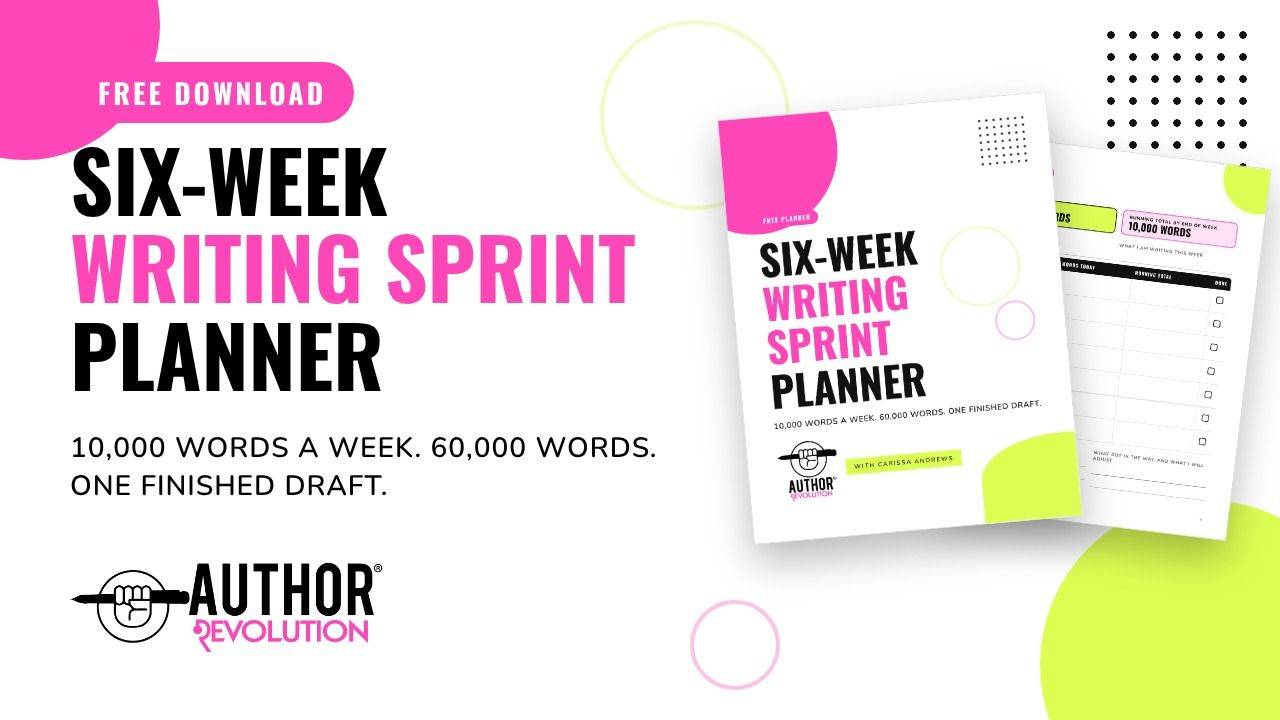
Free download
Six-week writing sprint planner
A printable planner for the six-week sprint I teach: about 10,000 words a week toward a 60,000-word first draft.
- Set up your book, your dates and your writing days
- A page for each of the six weeks, with a daily word log
- A finish-line page for what worked and what's next
It lives in your dashboard, so you can print a fresh copy for every book.
Keep learning how I teach
Short, practical posts on planning a series, finding a pace you can keep, and getting your books found.
- Oct 21, 2026How Many Books Should an Indie Author Publish a Year?Argues there's no single right publishing pace. It offers a five-step calculation for finding a sustainable schedule.Read the post
- Oct 14, 2026NaNoWriMo Is Gone: Your Best Options for November 2026Explains that NaNoWriMo closed in 2025 and lists current November writing challenges. It recommends a six-week sprint as an alternative to a one-month word-count goal.Read the post
- Oct 07, 2026Why Indie Authors Are Hard to Discover (and It's Not Your Fault)Attributes declining discoverability largely to platform algorithms outside authors' control. It suggests building owned channels, making series easy to find through search, and keeping a sustainable pace.Read the post