A NOTE ABOUT THIS EPISODE
I recorded this episode in December 2020. The Quickstart Kit I mention, the release dates for my own books and my plan to talk with Amazon about its algorithms are all out of date. The four-book pace I describe is still the framework I teach.
SUMMARY
Rapid releasing does not have to mean a book a month. I recorded this after about five years of working seven days a week and ending up with stress-related health problems, and I did not want to teach a version of rapid release that I found stressful myself. So I started calling the approach I teach sustainable rapid releasing.
In this episode, I walk through what a four-book year can look like if you start fresh on January 1. You spend the first two weeks plotting your whole series, then write the first draft of each book in a six-week sprint, aiming for roughly 50,000 to 60,000 words. That leaves about a month before the next book to send the finished one to your editor, plan your cover reveal and finish your marketing plan.
You can launch each book in the quarter it's finished, or save all four and release them close together at the end of the year. Either way, you repeat the plotting and sprint rhythm in April, July and October, which leaves March, June, September and December free of writing.
I also share what I saw releasing Windhaven Witches a month apart: steady sales each month, but not the big jump other rapid release authors described, and I was running ads on Facebook, BookBub and Amazon. I'm honest that there are no absolute guarantees. A rapid release strategy is a tool, and your books become a back catalog you can keep marketing.
WHAT YOU'LL LEARN
- Why rapid releasing does not have to mean a book a month
- What a four-book year can look like, from two weeks of plotting to a six-week writing sprint
- How long each book can be to fit a six-week sprint (about 50,000 to 60,000 words)
- Two ways to launch: book by book, or all four together at the end of the year
- Why I say there are no absolute guarantees, and why a back catalog is worth building
UPDATE FOR 2026
Today I frame this as a pace you set, not a speed you have to hit. Four books a year is the framework I teach, and you can choose to go slower. What I say here about monthly releases and Amazon is what I saw in 2020, so treat it as a snapshot.
KEEP LISTENING AND READING
- Is rapid release right for your books?
- How do I avoid rapid release burnout?
- How Do We Avoid Rapid Release Burnout?
- How to Leverage a 6-Week Writing Sprint
- What is Rapid Releasing?
WANT THE FULL PLAN?
Rapid Release Roadmap walks you through the six-week sprint and a pace of about four books a year. You set the pace. If you'd like everything I teach, the Library Pass opens all 23 masterclasses for a one-time $97.
FREQUENTLY ASKED QUESTIONS
Does rapid release mean publishing a book a month?
No. In this episode I say rapid releasing doesn't have to mean crazy numbers or a book a month. It means following a release strategy that builds your backlist faster than you may have done before.
What is sustainable rapid releasing?
It's the approach I teach: writing, publishing and promoting four books a year, with built-in time off from writing.
How long should my books be for a six-week writing sprint?
I suggest aiming for roughly 50,000 to 60,000 words. If you write longer books, you can tighten them or give yourself more time to write.
How much time off does a four-book year include?
If you plot for two weeks and then write for six weeks each quarter, you have four months a year off from writing: March, June, September and December.
Should I release each book when it's finished or all at the end of the year?
You have two choices. You can launch each book in the quarter it's finished, or save all four and release them close together, about a month apart, at the end of the year.
Does rapid release guarantee more sales?
No. I say there are no absolute guarantees. The likelihood goes up, but it's not 100%, which is why I also stress smarter marketing.
Read the full transcript
Edited for readability. Passages from the original recording that are out of date have been left out and are marked in brackets.
Welcome back to the Author Revolution podcast. I'm your host, international bestselling indie author Carissa Andrews and CEO of Author Revolution, the author source for all things Rapid Releasing.
[Out-of-date promotional section from the original recording removed.]
It's been ten years, guys, since I started writing with the goal of being published one day in mind. In this past decade, I'll be the first to say I have made a ton of mistakes.
From writing a first book in a series by the seat of my pants. Yes, I was a pantser to publishing it without a game plan, and not to mention having no clue when books two and three would actually launch. Then when they did launch, I had kind of a lackluster marketing plan, or pretty much zero in funds. You name it.
I have probably stumbled on it in my indie publishing journey. However, one of the biggest things this menagerie of mistakes has taught me is something that might actually surprise you. You have to protect your piece. It might sound a little strange to say it out loud like that, but there are those of us who are hustlers to the nth degree, and there are many of them who have been teaching things like rapid releasing and teaching that unless you're writing a book a month, you are failing at indie author hood.
Heck, you're failing at Rapid Releasing. With this mindset, though, it's no wonder that many people shy away from the concept altogether. I'll be honest, when I first heard of Rapid Releasing, I was partly in awe and partly in terror at the concept. I mean, there are some people out there who are capable of outputting an incredible amount of content very, very quickly.
Now, look, I have always been a fast learner and a fast decision maker, and I typically take on challenges others think are not simply to test myself, just to see, you know, if I can. Now, Rapid Releasing is certainly that kind of challenge. It is no joke, that's for sure. But from one overachiever to another, I can tell you there is still a breaking point.
Even if you love what you do, even if you adore your series, you can burn out faster than an asteroid entering Earth's atmosphere. Let me tell you a little story. For the past five years, I have cranked up my hustle, buying into the idea that more equals better. More books, more author coaching, more clients to help more hours put in.
I've worked seven days a week for longer than I care to admit and longer than I could actually remember. Now, while I have taken a couple of days off here and there, it's never been truly enough to unwind. Now, what's ended up happening is I've ended up with stress related health issues, things like TMJ. And we're not talking like simple TMJ either.
We're talking the kind of lockjaw to the point of having to have physical therapy every Wednesday for nine months. Yeah, it was that bad. I've gotten vertigo. I've gained weight during this time, which is, I suppose, not completely surprising considering that what I do is mostly sitting at a desk.
But what is surprising is that I've adjusted my diet and my workout schedule to accommodate that. Now, I've always been a workout junkie. Just ask Jillian Michaels. But it didn't even make a dent.
Now here's what I found out. I found out based off of my stress levels, my cortisol levels were through the roof. And combining that with the ripe old age of being 42, I am pretty much in a holding pattern until I get my stress levels back under control. Thus, the new vacation calendar for 2021 and renewing my promise to take Saturdays off.
Which, by the way, I have been successful since I mentioned it last month. Now, why do I tell you this? Well, because I don't want you to follow in my footsteps, at least not when it comes to this particular learning curve. I don't want you going up in flames and then burning down your author career because of it.
When I started creating the Rapid Release Roadmap program last year, I found myself struggling with the right direction to teach this concept because I didn't want to teach something that I personally found to be stressful and anxiety invoking. It wasn't until I finished up the Windhaven Witches series that I realized that the direction I wanted to take it in was something a little bit different. So with this in mind, I want to talk about the concept that I like to call Sustainable Rapid Releasing. Now, we've touched briefly on this topic before, but I truly believe that we, as in the authors who want to make a career out of our writing, need to follow a sustainable release pattern.
And in my eyes, what I teach in rapid release roadmap on how to embrace a sustainable, rapid release schedule is by writing, publishing and promoting four books a year. Rapid releasing doesn't have to mean crazy numbers here, guys. It doesn't have to mean a book a month. It simply means you're following a release strategy that builds your backlist faster than most, and maybe even faster than you've ever done in the past.
So, to give you an idea of how I envision a four book sustainable rapid release strategy, let's look at it as if we're starting 100% fresh on January 1st. Now, for the sake of this example, I'm also going to assume that you're starting out without any plot or series concept as of just yet. If this sounds like you, the way I would work it is that the first two weeks of January would be spent completely in plot generation. That means planning out your entire series in one go, spend a couple of hours a day, or at least two days back to back, where you sit down and just hash out all the plot lines of your books, come up with the series arc, come up with the book arc for all four books, and then at the very least, do a chapter by chapter synopsis for the first book.
Trust me, you will thank yourself later. And if you have the time, because let's face it, two weeks is still a pretty decent amount of time to be able to do some planning and plotting. If you still have more time, continue on with the rest of the books. I did this with the Windhaven Witches series, and I found even though I tweaked and adjusted my outlines, having that concept of knowing what's coming down the pipe a little bit further into other books allows you to write your first draft in a way that is way more dynamic than if you didn't understand what was coming in, let's say book four.
All right, so assuming you get your plotting done, I want you to then spend the next six weeks on a writing sprint. So that means you hammer out that first draft pretty much NaNoWriMo style, by getting all the words down between the middle of January and the end of February. Now, ideally, this means planning for a book to be right around the 50,000 to 60,000 word mark. Now, if you write longer books than that, either consider writing slightly shorter novels.
So maybe compact your novels a little bit more in order to make this rapid really strategy work for you, or give yourself a little bit more time for the writing if you need to. But if you were able to reduce your novels down to the 50 to 60 work mark, that's perfect. Shorter works even faster. So by all means, if you are a novella writer, go for it.
But what this means is that by March 1st, that first book is done ideally anyways, and you have then a month, a full month before having to start writing your next book. This gives you a nice little cushion and break to chill out, relax, maybe have a little bit of time to hang out with a family. Go on a vacation without having to worry about your workout goals, whatever. But it doesn't mean that your work is 100% done though, right?
It means that during those next four weeks, you're still wanting to get things under way. Things like sending your book to the editor. Planning your cover reveals. If you haven't done that already, finalizing your marketing plan for the release.
All of that good fun stuff. Then you have two launch choices. Either you decide to launch this book that was just finished in quarter two, meaning sometime between April and June, or you can decide to save it and pile it up so that all four of your books can rapid release close together at the end of the year. Say a month apart, like I just did with Windhaven Witches, which is a series I wrote that entire series starting in, I think it was about November, is when I started tweaking book one, and I wrote the rest of the series through this whole year, and then rapid release them all September, October, November and December.
Now, truthfully, based on my experience this year, I haven't found an exponential growth pattern happening with Windhaven Witches and its monthly release strategy. I know other rapid release authors who say that when they've released a book a month apart, they see these huge gained by the time they hit book four with very minimal advertising. What I've seen is a little different. I've seen consistent sales each month based off of the releases, which has been fantastic.
But I do have ad spend on Facebook, Bookbub and Amazon for the series itself. So I'm not coming out a huge, overwhelming amount ahead, but it's still enough to be thankful for. Absolutely. But I'm not seeing that huge, momentous stride either.
So with this, my hypothesis, at least as of right now, is that the book launch a month strategy is losing some of its traction within Amazon. If that's the case, then this idea of writing and publishing as fast as humanly possible is really a moot point.
[Out-of-date detail removed.]
Now, regardless of your release pattern. It means that you repeat this writing process starting again in April, then July, then October.
But following the two week planning, plotting, and then six week writing sprint. So this means you will always have four months a year off from writing March, June, September and December. I mean, who doesn't want December off from writing? Other than me, of course.
This year where I slacked off in November for NaNoWriMo, but I digress. I don't know about you, but the breathing room in there feels very doable even for me. Who has Author Revolution to run, client work I'm still trying to work on, and a zoo full of kids, so if I can do it, even if you're working another job or have kids who are home from school and homeschooling sort of, I think you can probably do it too. Don't you?
Look, at the end of the day, the rapid release strategy is just a tool to help you boost your visibility, grow your backlist, and ultimately put you on a path to earning a living from your writing. Now, I don't know about you, but that's a goal most of us are striving toward, right? While the idea that the faster we write and publish, the faster we get to financial stability sounds sexy. Unfortunately, there's still no absolute guarantees.
While the likelihood goes up, it's not 100%. So that means we have to work smarter and not harder with our marketing. And I believe a lot of that really comes down to some intelligent email marketing funnels. But that's a topic for a different day.
Just know that your books, no matter how many you publish or how many you produce, they all go into this back catalog that ultimately is an evergreen content that you can market and bring people into your world at any time, which is a pretty fantastic place to be, if I'm quite honest with you.
[Out-of-date promotional section from the original recording removed.]
All right, my writerly friend. That's it for this week.
[Out-of-date detail removed.]
I want you to go forth and start your Author Revolution.
LISTEN TO THE PODCAST
Listen on Buzzsprout or find it on your favorite podcast platform.
Free download
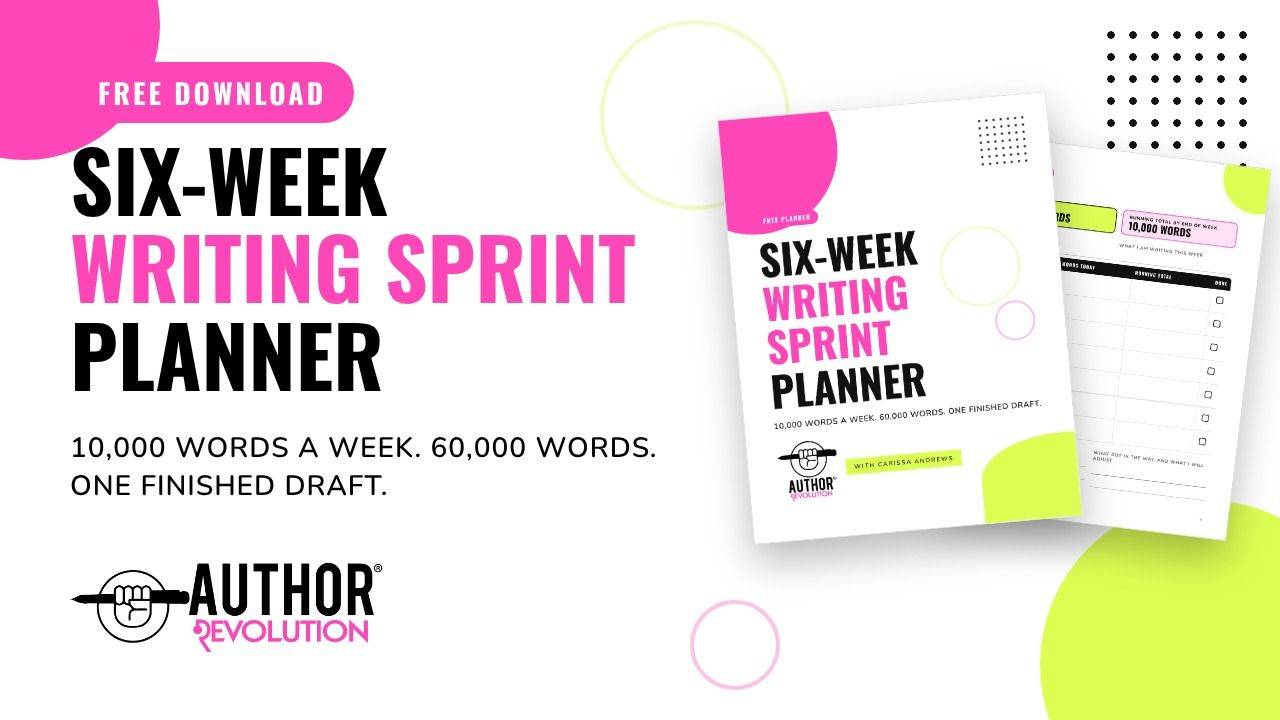
Six-week writing sprint planner
A printable planner for the six-week sprint I teach: about 10,000 words a week toward a 60,000-word first draft.
- Set up your book, your dates and your writing days
- A page for each of the six weeks, with a daily word log
- A finish-line page for what worked and what's next
It lives in your dashboard, so you can print a fresh copy for every book.
Keep learning how I teach
Short, practical posts on planning a series, finding a pace you can keep, and getting your books found.
- Oct 21, 2026How Many Books Should an Indie Author Publish a Year?Argues there's no single right publishing pace. It offers a five-step calculation for finding a sustainable schedule.Read the post
- Oct 14, 2026NaNoWriMo Is Gone: Your Best Options for November 2026Explains that NaNoWriMo closed in 2025 and lists current November writing challenges. It recommends a six-week sprint as an alternative to a one-month word-count goal.Read the post
- Oct 07, 2026Why Indie Authors Are Hard to Discover (and It's Not Your Fault)Attributes declining discoverability largely to platform algorithms outside authors' control. It suggests building owned channels, making series easy to find through search, and keeping a sustainable pace.Read the post