A NOTE ABOUT THIS EPISODE
I recorded this episode in May 2020, during the pandemic. I talk about my own plans for 2020 and 2021, including my courses, my writing schedule and my local writing group, and I invite you to a Facebook group and tease the next episode. Those details are out of date. The questions I ask about your vision still stand.
SUMMARY
Most of us never stop to get clear on what we want, what we want to be known for, or how we'll get there. I open the episode with that, and with a book I was reading at the time, The Vision Driven Leader by Michael Hyatt. Rapid releasing is one rung on the ladder of big goals. You could choose a different rung, but what matters is having clarity about your journey forward.
I share that for years I asked myself the wrong questions: why am I still struggling, and will this next book launch my career? The better questions were where I want to be in 3 to 5 years, which author business model I want, and how long it will take me to reach 22 to 28 books.
Then I walk through how I get clarity. Hyatt calls the first step distance: remove yourself from your daily grind so you have a quiet mind and a quiet space. Next you get curious and follow the rabbit holes with questions. There's no judgment here, and you may find out rapid releasing isn't where you want to go, or that limiting beliefs have been holding you back.
Finally, I say clarity needs to turn into a plan: the strategies, deadlines and action steps that fit your books. That can take practice and experimentation. I also say a clear vision spurs us into action, while endless possibilities stunt us.
WHAT YOU'LL LEARN
- Why clarity of vision comes before a rapid release plan
- What Michael Hyatt calls distance, and how to give yourself quiet space to think
- The kinds of questions I ask myself to get clear on my author goals
- Why you might find out rapid releasing isn't where you want to go, and how limiting beliefs can show up
- How to turn that clarity into a plan with strategies, deadlines and action steps
UPDATE FOR 2026
Today I teach rapid release as a pace you set, and slower is a fine choice. The questions in this episode are still a good way to work out which pace is yours.
KEEP LISTENING AND READING
- Is rapid release right for your books?
- How many books should an indie author publish a year?
- How Do We Avoid Rapid Release Burnout?
- Is There Such a Thing as Sustainable Rapid Release?
WANT THE FULL PLAN?
Rapid Release Roadmap walks you through the six-week sprint and a pace of about four books a year. You set the pace. If you'd like everything I teach, the Library Pass opens all 23 masterclasses for a one-time $97.
FREQUENTLY ASKED QUESTIONS
What is clarity of vision, and why does it matter for rapid releasing?
I describe it as knowing where you want to be as an author, what you want to be known for and how you want to get there. I call it a compass pointing the way, and say rapid releasing is just one rung on the ladder of big goals you can choose.
How do I get clarity on my author goals?
I borrow Michael Hyatt's first step, distance. Remove yourself from your day-to-day responsibilities, whether that means a day off work or getting out of the house, so you have a quiet mind and a quiet space. Then get curious and ask yourself as many questions as it takes.
What questions should I ask myself?
A few from the episode: where do I want to be in 3 to 5 years, how many books would I like to have published, what do I need to change to make my goals happen, what do I want my readers to feel when they read my books, and what does my ideal day look like.
What if I find out rapid releasing isn't for me?
I say that's possible, and there's no judgment. You might also find that limiting beliefs were telling you rapid releasing was impossible, or that a series written and published quickly couldn't be any good. The goal of the exercise is to clear the path so you can see where you're going.
Do deadlines and plans get in the way of creativity?
I say it's the opposite. We're stunted by infinite possibilities and spurred into action by a clear vision, and limits like deadlines give you a reason to find a creative way through.
What do I do once I'm clear on what I want?
Let that clarity turn into a plan. Decide which strategies you'll use, including whether rapid releasing is one of them, what deadlines you need, and the action steps to get there. I say this can take practice and experimentation.
Read the full transcript
Edited for readability. Passages from the original recording that are out of date have been left out and are marked in brackets.
Well. Hello again and welcome to a new episode of the Author Revolution podcast. I'm your host, international bestselling indie author Carissa Andrews and CEO of Author Revolution, the author source for all things Rapid Releasing. Okay, so have you stopped to think about yourself and your future self as an author?
Do you take some quiet time just to dream about your vision for writing and publishing? Well, if you've answered no, you're definitely not alone. Most people don't stop to get clear on what they want, what they want to be known for, or how they want to get there. We're not just talking authors here either.
We're talking everyone from Joe Schmo down the street to some of the most powerful and influential leaders of the world. I'm in a somewhat unique position. I guess I could say I'm not just an author as a friend, just as a word that can actually be used for such a role. But I'm also a business leader and a nonprofit leader.
I'm not always as great of a leader as I could be, but I am always striving to be better than I was yesterday. Now the past few weeks, I've been thinking a lot about what my vision is for my life, for my business, and of course, my nonprofit. In fact, I'm reading a book right now called The Vision Driven Leader by Michael Hyatt. Have you heard of it?
I have it on audiobook and in hardcover, because I'm that interested in trying to get clear on what my vision and my purpose is in all the different areas that I actually deal with.
[Out-of-date detail removed.]
In The Vision Driven Leader, Michael Hyatt also has so many interesting tidbits that's given me food for thought. I've always been someone who likes to think strategically so I can put things into motion, not just think about them, but actually take action. But he goes beyond just the strategic to talk about the clarity of vision.
It takes in actuality to even manage to do any of it. So when we decide to become authors, we're reaching for a big goal of one day being published. Then with that goal is realized, our next hurdle is really to continue that momentum, to continue our forward trajectory as an author. Rapid releasing is just another rung on the ladder of those big, bold goals that we can make for ourselves.
You could choose a different rung, but what matters is having clarity in your journey forward. As soon as we accept a clear path toward our author goal and our author career. It instantly helps us to prepare for a future of our own making. George Bernard Shaw said some men see things as they are and say, why?
I dream of things as they never were and say, why not? I believe as authors we think along those lines of Shaw. We write because something inside of us sees things that were never really there. But they need to be things that need to be thought of, dreamed about, experienced.
However, so many of us do this as almost a one off. We have a really great idea, something that is just fantastic flash of insight and we have to write it down. But then once it's done, we're left asking ourselves, well, what now? This is why I'm so incredibly glad I didn't reach that instant.
Fame and success so many people dream of, especially authors having built a solid foundation to spring from. I'm no longer worried about what comes next. Instead, I'm focused on what it is I actually want to come next. Throughout the years, I've asked myself over and over, why am I still struggling?
Why are my royalty is not where I think they should be at this point? Will this next book be the thing that finally launches my career? And you know what I've realized? I've been asking myself the wrong questions I should have been asking.
Where is it I really want to be in the next 3 to 5 years? Or what author business model do I want to take? Or how long will it take me to get to the 22 to 28 books? Or even how do I become a New York Times bestselling author?
Luckily, I did ask that question, but instead, up until fairly recently, past couple of years, I guess my focus was pretty scattered. My vision was blurry on how to get the books out there and which books I really wanted to do while my friends. If there's one thing 2020 is good for, it's getting clarity of vision. See what I did there?
I totally did that. Sorry. It was a vision joke. I had to do it.
[Out-of-date detail removed.]
Here's why it's so important for us author nerds to get clarity. Our lives as authors can be better tomorrow than they are today. We can reach more readers, impact more lives, and yes, earn more money. But wouldn't it be nice to know, in a few years time, that you've taken your author career to those new heights?
Wouldn't you love to see your readership go up and the engagement with you grow up in a way that you never thought could happen? Wouldn't it be a relief to know exactly how and when to publish your books? So there's no more obscurity, and you're able to publish with complete confidence? This, again, is why we need clarity.
It's like our compass pointing the way to the future of our making. So how do we go about getting clarity of vision? Does lightning just strike? And it's like all is right in the world.
Oh, do I wish. Alas, it takes a little bit of something that you might not overly want to give it space to breathe. It means removing yourself from your ordinary grind, whether that includes daily writing or not. Whether it means being in your house and having to get outside of the house, taking a day off from work, whatever it might be, you need to remove yourself from the day to day responsibilities that you usually deal with, so that you can surround yourself with the quiet space of possibility.
In The Vision Driven Leader, Hyatt calls this step distance. Essentially, it's the same thing. You have to have a quiet mind and by extension, a quiet space around you. Maybe even one that is totally different just to be able to kick up that creativity.
Next, when you're quiet and ready, it's time to get curious. Yes, like Curious George, as my kids would say, I need you to stop, to try to control your dreams and to follow all of the rabbit holes for a change. Ask yourself some questions to get your mind on the right track and keep focused on them. Think about them in a way that inspires you.
Things that can actually lift you up and make you excited about what it is you're doing. Some of the questions could be like, what other goals scare me most? Where do I want to be in those 3 to 5 years? And how many books would I like to have published?
If an oracle like Diana Hawthorne could tell me precisely how to move forward in my author career, what would I most want to know? What do I need to change in order to make my goals happen? What sorts of stories could I write to reach my goals faster? What could I give up in order to boost my goals?
What do I want my readers to feel when they read my books? And am I accomplishing that right now? Is there a mentor I could be working with that could help me reach my author goals? What is my subconscious drawing me to right now?
What shows, movies, books, events, etc.? I want you to look for patterns here. What would make readers beg for more books? What does my ideal day look like?
What tools do I need to acquire to make my life easier as an author? And finally, could hiring a PA even help me reach them quicker? Ask as many questions as it really takes to get clear on what it is you want with your writing and your author goals. There's really no judgment here.
You might even find out that this process opens up the fact that Rapid Releasing isn't really where you want to go. However, you might find that limiting beliefs were actually holding you back, telling you rapid releasing was impossible, or that there was no way a series written and published quickly could be any good. Oh, trust me, I've been there. And even better yet, you might get 100% clear on all of your next steps.
The goal of this exercise is to clear the path so that you can see where it is you're going. While you could totally pants it, just like with writing a good book, it will often take longer to get to your destination and you'll probably end up doing it. A little bit confused. Not only that, your execution will be half-assed and more than likely, your overall impact will be stilted.
You know, by now, Guy is right. You gotta have a plan. Nothing extraordinary in life happens without one. So once you get clear on what it is you want to do in order to take your author career to the next level, then you'll have to go ahead and dig deeper into how it is you're going to get there.
Determine your execution and the exact strategy and steps you need to take in order to make everything work. In order to make it sink and click and start moving along like clockwork. This might even take some time, and it might take longer than that day away from the office, because sometimes it takes practice and experimentation to find out what really does work for you. Sometimes it even takes a whole lot of creativity.
But we're all authors, so we have that in spades, right? Oftentimes others think that being constrained by things like deadlines or strategies or outlines will stifle their creativity, but actually it's the exact opposite. We are stunted by the infinite possibilities and spurred into action by a clear vision. In fact, limitations in the form of writing give us a way to have to be creative, because now you're going to have to write and find a way outside of the box.
It's really an interesting and fascinating situation. So writer's block happens when you're not clear on where you're writing, what you're writing, why? And the same goes for publishing consistently. When you don't have a defined goal or a vision in mind.
It's so easy to put it off. We're so good at putting ourselves last and everybody else first. It's time to put yourself first and your vision first. Who's with me?
Now to recap. In order to get clarity of vision. You need space to breathe and focus on what you really want. Ask yourself as many questions as needed to get clear.
Follow as many rabbit holes as necessary to understand what you want as an author overall. Next, you're going to want to allow that clarity to unfold into a plan of action with your books. What strategies do you need to implement to make them happen? Is rapid releasing one of them?
What deadlines do you need to put into place? Then finally, you need to take the action steps necessary to help you get there.
[Out-of-date promotional section from the original recording removed.]
Well, there you have it, my friend. I truly believe that having clarity in our lives can lead us to greatness, and this is something that I've delved into a lot, even with my previous books.
[Out-of-date detail removed.]
And really, honestly, author imposter syndrome. We all are dealing with our own unique forms of imposter syndrome and things that we need to overcome as authors so that we can go on to live our best, most fulfilling author careers. And I know that we really can do this as long as we just get out of our own way. Getting clarity really does filter into everything we do, from our author careers to the books we write, to ultimately, the lives we live.
And I know that in order to get clarity, it does take just that little bit of time and effort to understand ourselves and understand where it is our hearts are really trying to take us. All right, guys, until next time. I want you to go forth and be awesome.
LISTEN TO THE PODCAST
Listen on Buzzsprout or find it on your favorite podcast platform.
Free download
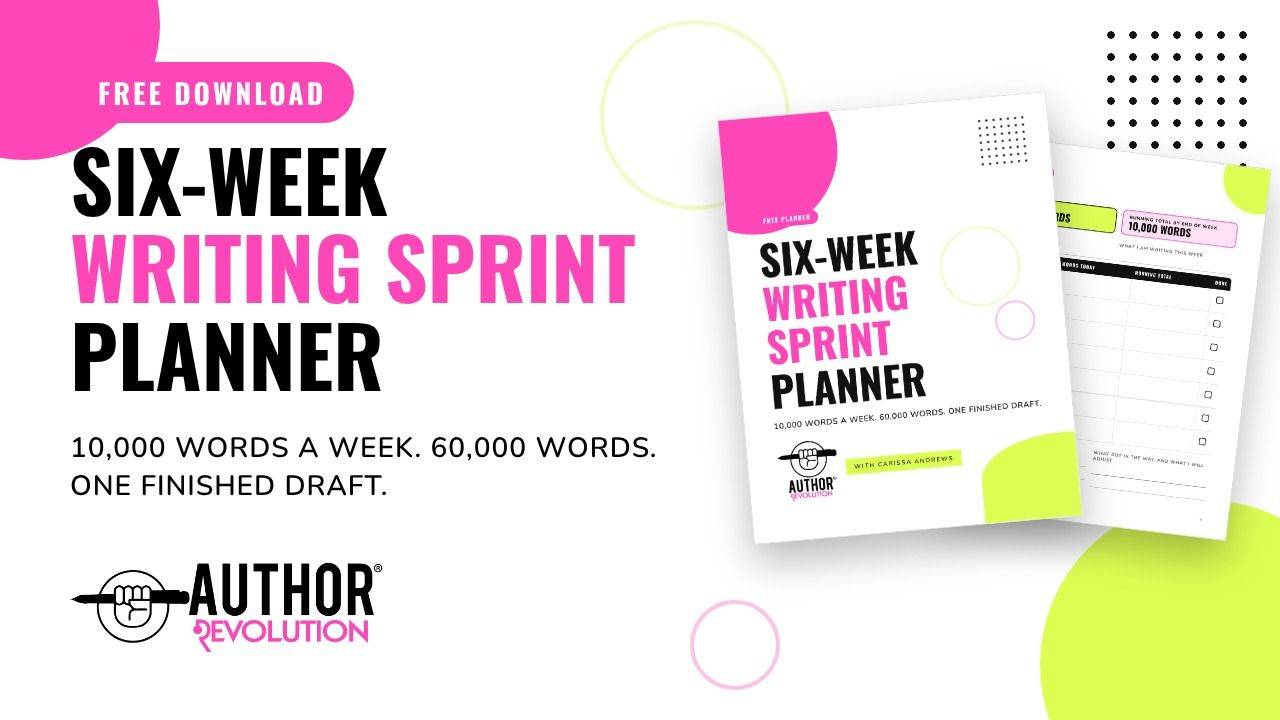
Six-week writing sprint planner
A printable planner for the six-week sprint I teach: about 10,000 words a week toward a 60,000-word first draft.
- Set up your book, your dates and your writing days
- A page for each of the six weeks, with a daily word log
- A finish-line page for what worked and what's next
It lives in your dashboard, so you can print a fresh copy for every book.
Keep learning how I teach
Short, practical posts on planning a series, finding a pace you can keep, and getting your books found.
- Oct 21, 2026How Many Books Should an Indie Author Publish a Year?Argues there's no single right publishing pace. It offers a five-step calculation for finding a sustainable schedule.Read the post
- Oct 14, 2026NaNoWriMo Is Gone: Your Best Options for November 2026Explains that NaNoWriMo closed in 2025 and lists current November writing challenges. It recommends a six-week sprint as an alternative to a one-month word-count goal.Read the post
- Oct 07, 2026Why Indie Authors Are Hard to Discover (and It's Not Your Fault)Attributes declining discoverability largely to platform algorithms outside authors' control. It suggests building owned channels, making series easy to find through search, and keeping a sustainable pace.Read the post