A NOTE ABOUT THIS EPISODE
I recorded this on November 17, 2020, in the middle of NaNoWriMo, which shut down in 2025. The sponsor read, the show notes promises, and the review and Patreon asks are out of date, and the tools and books I mention may have changed since then. I also mention kids doing distance learning, which was true that month. The catch-up tips themselves still apply to any writing sprint.
SUMMARY
I recorded this with a confession: I was bombing NaNoWriMo. It was the 17th of November and I hadn't written a single word of my next book. I'd just finished the Windhaven Witches series and was switching to a new one, and the truth was that I hadn't been clear enough on my story. I had a skeletal outline, but not the detailed one that always makes me faster. So I shared the tips I was giving myself.
The first is to reassess your situation. From the 17th, hitting 50,000 words by December 1 meant 3,333 words a day, which I say is doable for me, a chapter and a half, if I have a good outline. The second is to get clear on your story. Block off two to four hours for a quick skeletal outline, your three acts, or a stuck plot point. I mention Plottr, Scrivener, Scapple, and a plot generator from Reedsy.
Tip three is to dig into resources, like older episodes, NaNoWriMo's prep resources, and the tutorials for your planning tools. Four is to get a prompt book to switch from left brain task management to right brain creativity, and I mention a fantasy prompts book and Reedsy's weekly prompts. Five is to talk with a writerly friend, like my husband, Colin, or my friend Jenny, or hop on a Zoom call.
The bonus tip is to reassess your due date if you miss 50,000. I say one word is still one word less to think about, and I name a specific goal for myself: the first two chapters, around 4,000 words. I close on the mantra "progress, not perfection."
WHAT YOU'LL LEARN
- How to figure out the daily word count you'd need to catch up
- How to get clear on your story in two to four hours, and the tools I use
- Where to find resources, prompts, and brainstorming help when you're stuck
- Why I suggest a specific goal, like two chapters, when you're behind
- How to reassess your due date and keep going if you miss 50,000 words
UPDATE FOR 2026
NaNoWriMo shut down in 2025, but the catch-up approach works for any writing sprint, including the six-week writing sprint. The tools I mention may have changed since 2020, so check what each one offers now. If you're looking for what to do instead of NaNoWriMo, I put my ideas in this post.
KEEP LISTENING AND READING
- What are the best NaNoWriMo alternatives?
- What are 5 tips for taking on NaNoWriMo?
- What are good self-care tips for writers during NaNoWriMo?
- How do you stay productive and focused during NaNoWriMo?
- What's a Better Alternative to NaNoWriMo? The Six-Week Writing Sprint
WANT THE FULL PLAN?
Rapid Release Roadmap walks you through the six-week sprint and a pace of about four books a year. You set the pace. If you'd like everything I teach, the Library Pass opens all 23 masterclasses for a one-time $97.
FREQUENTLY ASKED QUESTIONS
How do you catch up if you're behind on NaNoWriMo?
I give five tips and a bonus: reassess your situation, get clear on your story, dig into resources, get a prompt book, talk with a writerly friend, and reassess your due date. I say there is always time to refocus, wherever you are in your NaNoWriMo journey.
How many words a day do you need to catch up?
I did the math from the 17th of November. To write 50,000 words by December 1, I'd need 3,333 words every day. I say that's doable for me, about a chapter and a half, as long as I have a good grasp on my story and a good outline.
Should you outline when you're behind?
I say yes, because you can't write fast when you don't have a clear destination, whether you're a pantser or a plotter. I suggest blocking off an afternoon, two to four hours, to do a quick skeletal outline, get clear on your three-act structure, or figure out a plot point that's been holding you up.
What tools can help you plan a story?
I mention four. I use Plottr to map plot lines visually and see where they intersect, Scrivener for outlining and worldbuilding, Scapple to brain dump the places, people, and events in a story, and the Reedsy plot generator for a quick, random one-liner in your genre. Check each one for its current features.
What if you're stuck or unmotivated?
I suggest digging into resources, like older episodes of this podcast or the NaNoWriMo prep 101 resources page. I also say that Plottr and Scrivener both have video tutorials that can get you excited about writing again.
Do writing prompts help?
I say a prompt book helps me switch from left brain task management to right brain creativity mode. I mention a fantasy writing prompts book that helped me with a third plot line, and Reedsy's weekly writing prompts, which come to your inbox or can be browsed on their site.
How can a writing friend help?
I suggest a brainstorm session, since sometimes we're trapped in our typical pattern of thinking. I turn to my husband, Colin, and my friend Jenny, who look at problems differently than I do, and I say what comes out is almost always a stronger storyline. You could hop on a Zoom call, and they may be stuck too.
What if you don't reach 50,000 words by the end of November?
I say what matters is that you made progress on your novel, and that one word is still one word less to think about. If you miss your target, reassess your due date and keep hammering at it. I suggest setting a specific goal, like my two chapters, which is around 4,000 words for me.
How do you keep going when life gets in the way?
I say to repeat the mantra "progress, not perfection," which I admit can be a bitter pill for overachievers. I say we can stress over the small stuff or roll with the punches and keep making forward strides.
Read the full transcript
Edited for readability. Passages from the original recording that are out of date have been left out and are marked in brackets.
Welcome back to the Author Revolution podcast. I'm your host, international bestselling indie author Carissa Andrews and CEO of Author Revolution. The indie author source for all things rapid releasing.
[Out-of-date promotional section from the original recording removed.]
Well, I gotta say it, guys, I am absolutely bombing NaNoWriMo.
I had hope to get a head start on the men's this month by taking Nano on. But here we are on the 17th of November at the time of this recording, and I have a confession to make. I haven't written a single word, not one. It's kind of sad when I think about it.
Are you in the same boat? Maybe you are. Or maybe you've been writing, but not quite hitting your 1,667 words per day goal wherever you are in your NaNoWriMo journey. Know that there is always time to refocus.
Now, I could go into a long list of reasons why I haven't had the chance to start yet, but really, the truth of the whole matter is I haven't been clear enough on my story. I have a skeletal outline created, but I haven't put in the time to create a detailed one, which is something I found always increases my speed and motivates me to get my writing on. Do you feel the same way? Now, while I may not have started writing amend.
I know as soon as I do, things will start to jive and going forward with subsequent books in the Diana series, things will get easier. And I've been at this for a number of years, and for whatever reason, this is just the way it works with me. I've just finished up the whole Windhaven Witches series, and I'm swapping to an entirely new series of books, so my brain's just not 100% in it yet. My only saving grace is that I've written the first book and kind of know the characters pretty dang well at this point.
Well, it's a saving grace, or perhaps kind of a procrastination present. I don't know. Who knows? It's something like that.
But if you're like me and you're sitting here in the middle of NaNoWriMo, it's going into week three and you're thinking, you better get a move on. I do have some tips to help you get focused and back on track. So let's go over. Tip number one is to reassess your situation.
Now, if I were going to try to catch up on NaNoWriMo starting as of right now, the first thing I would do is reassess all of my targets because it's the 17th already. And in order to write 50,000 words by December 1st, that means I would have to write 3,333 words every single day between now and December 1st. I thought that was a cool number, by the way. 3,333.
I couldn't plan that any better because three is like my bestest favorite number. All right. But first of all, let me just say that 3,333 words. That's actually pretty doable.
Still, it's not over the top. It's not, you know, 20,000 words per day or anything like that. 3,000 is, for me anyway, a chapter and a half that would need to be completed. So if I were to plan a chapter in the morning and maybe half of a chapter in the afternoon, I could make that happen.
However, like I said earlier, though, that's when I have a really good grasp on my storyline and have my good outline and everything in place. So when I don't have that, that brings us then on to tip number two, which is get clear on your story. I know it's a shocker, right? You can't write fast when you don't have a clear destination.
At least not in my books anyway, and definitely not accurately. Whether you're a pantser or a plotter, the next thing you need to do when you know your daily target is to spend time getting crystal clear on that story. So what I want you to do is block off an afternoon. 2 to 4 hours should be plenty of time to get clear enough to start making progress on the story itself.
It doesn't matter if you do a quick skeletal outline, get clear on your three act structure, or just have time to really figure out a plot point that's been holding you up. Whatever getting clear is for you. I want you to take the time and do it. You'll thank yourself later.
For me, I've been using Plottr to map out the three separate plot lines running through a means. What can I say? I can never do things the easy way, right? That's probably also part of the reason I've been procrastinating writing the story.
However, Plottr has been invaluable at allowing me to plan things in a visual way so I can see where the three different plot lines intersect. It's really a brilliant program. Now, in the past, I will say that I have used Scrivener for planning my outline and diving into my worldbuilding, which are two separate things in addition to where I write my book. It's a crazy, powerful tool, and if you're using it to write regularly, you can already take advantage of all those things, including the outlining process as well.
Now, if you're confused about who or what is going into your story, you might want to consider getting Scapple. Now, Scapple is kind of like the sister program to Scrivener. It's owned by the same company, Literature & Latte. And I use Scapple to brain dump or my map out all of the places, people, significant events that are going on in my books situation, whatever it might be.
So in the case of Diana, I mapped out Diana Hawthorne and anybody who has had contact with her throughout all of the different books that I've written because she's, for whatever reason, really bossy and likes to go into other people's books and stories. So I wanted to make sure that there was nothing and no one I was missing in it. Create it really quick visual that helps me not only with plot generation, but in not forgetting someone or something that's happened to her that might have existed in a different book that isn't even a part of her own series. So speaking of plot generation, I have one other resource I'd want you to look into, and that is the Reedsy plot generator.
It's a fun way to generate random plots, and even allows you to pick the genre you're writing in. It's super simple and fun to do, and it gives you like a really quick one liner, letting you kind of imagine and let your imagination run wild. All right. Tip number three is dig into resources.
Look, you are never alone in this. If you're feeling stuck, maybe you need to dig into some writing resources and whether that be binging other older episodes of this podcast, or by heading over to NaNoWriMo website and going through their NaNoWriMo prep 101 resources page. There is a wealth of information just waiting for you to dig into and get inspired. If you're planning on using one of the programs I listed in the tip before this, you can also get some incredible tips from their sites as well.
Both Plottr and Scrivener have video tutorials and plenty of resources to make your novel shine and get you excited for writing again. Okay, tip number four get a prompt book in order to poke my creativity bear. I guess I have a number of writing prompt books that I refer to from time to time, especially if I'm feeling kind of stuck. They're a great springboard for switching my focus from left brain task management to right brain creativity mode.
So for a men's, I just purchased the book 500 Fantasy Writing Prompts by Erica Blumenthal. It was perfect for stoking my imagination and coming up with some unique situations for a men's. I had a third plot line that I was trying to create, and there was just a little tiny element I knew I was missing, and I wanted to get inspired, and the book did just that for me. And so now I have all three of these outlines ready to rock and roll, and I just need to kind of flesh them out a bit more.
[Out-of-date detail removed.]
I have one other resource. It's not really a prompt book per se, but really in addition to the plot generator, they do weekly writing prompts. So it's kind of the same thing is just that you get them into your inbox, or you can head over to their website and check them all out and sort through them right then and there. It's really kind of a neat thing.
So if you're ever in the situation of wanting to just be inspired and get some writing prompts sent you each week, Reedsy, there's a place to go
[Out-of-date detail removed.]
All right. Tip number five. I want you to talk with a writerly friend. If you are still feeling stuck or unmotivated to keep going for NaNoWriMo this year, consider a brainstorm session with another writerly friend.
Sometimes we just get blocked because we're trapped in our typical pattern of thinking. So when you tap into someone else's thought process, it can spur on new ideas and invigorate your story. Kind of like the idea of the writing prompts in the first place. I can't tell you how many times I've turned to my husband, Colin, and asked him what he would do if X, Y, Z, or even my close friend Jenny.
Both of them have this incredible way of being able to look at the world differently and give me some really great food for thought and fodder for playing around with. So the point here is, both of these people have totally different ways of looking at and coming out problems and finding solutions than I do. And when we get to talking shop, what comes out is almost always a stronger storyline. So why not hop on a zoom call with a friend and get chatting about your story?
You never know. Maybe they're stuck too and you guys can help each other. All right, I have a bonus for you. You know me by now.
If you've been listening to this podcast. Whenever I have tips, I usually have a bonus for you. So bonus tip I want you to reassess your due date. Look, at the end of the day.
NaNoWriMo is meant to be a fun way to increase your speed, get you engaged with other authors, get words on the page, and of course, get out of your own way. Now, if for some reason you aren't able to make the 50,000 goal by the end of the month, what really matters is that you made progress on your novel. I don't care what that progress looks like right now, one word is still one word less to think about. So if you reach the end of November and you find you've missed your target, just reassess your due date and keep hammering at it.
Now, for me, a mentor is due to the editor January 1st. So my time for procrastination is coming to a very swift end. Not only do I have my editor hanging on my manuscript come January, but I also have a blog tour scheduled for its release as well. So failure here not really an option.
Here's what I promise to you. I will get the rest of my outline nailed down and start writing this week. But more than that, I promise to write the first two chapters minimum. And the reason I'm telling you two chapters is because you have to have a specific goal to write to.
So just writing in general, that could mean that I'm just going to kind of maybe do two sentences. So roughly, for me, in my world, two chapters is around 4,000 words. Now, while it might not seem like a ton just yet, I also have to be realistic about the situation and myself right now too. Now, I don't know who else needs to hear this, but all of the schools have closed down and gone to distance learning.
So that means even the kindergartner is home. And let me tell you, that has been a cluster of epic proportions. They are trying to get him, for whatever unruly, ungodly reason, into Google Chat three times a day for an hour apiece. It's torture for him and it's torture for me.
Needless to say, it's slowing down my progress on pretty much everything. As we try to get used to this new norm. Goodness only knows how long this is going to be too. It's not like there's an end in sight just yet.
So the key here for you and for me right now is to repeat the mantra. Progress. Not perfection. That might be a bitter pill to swallow for those of us who are overachievers.
And if you're listening to this podcast, I can pretty much guarantee you are one. But it's still the truth of the matter. We can stress over the small stuff and let it drive us crazy. Or we can roll with the punches and keep making those forward strides.
[Out-of-date promotional section from the original recording removed.]
All right, my writerly friends, I am off to actually get that outline nailed down so that I can begin that writing process. Whatever your plans are for the rest of the week. I want you to go forth and start your author revolution.
[Out-of-date promotional section from the original recording removed.]
LISTEN TO THE PODCAST
Listen on Buzzsprout or find it on your favorite podcast platform.
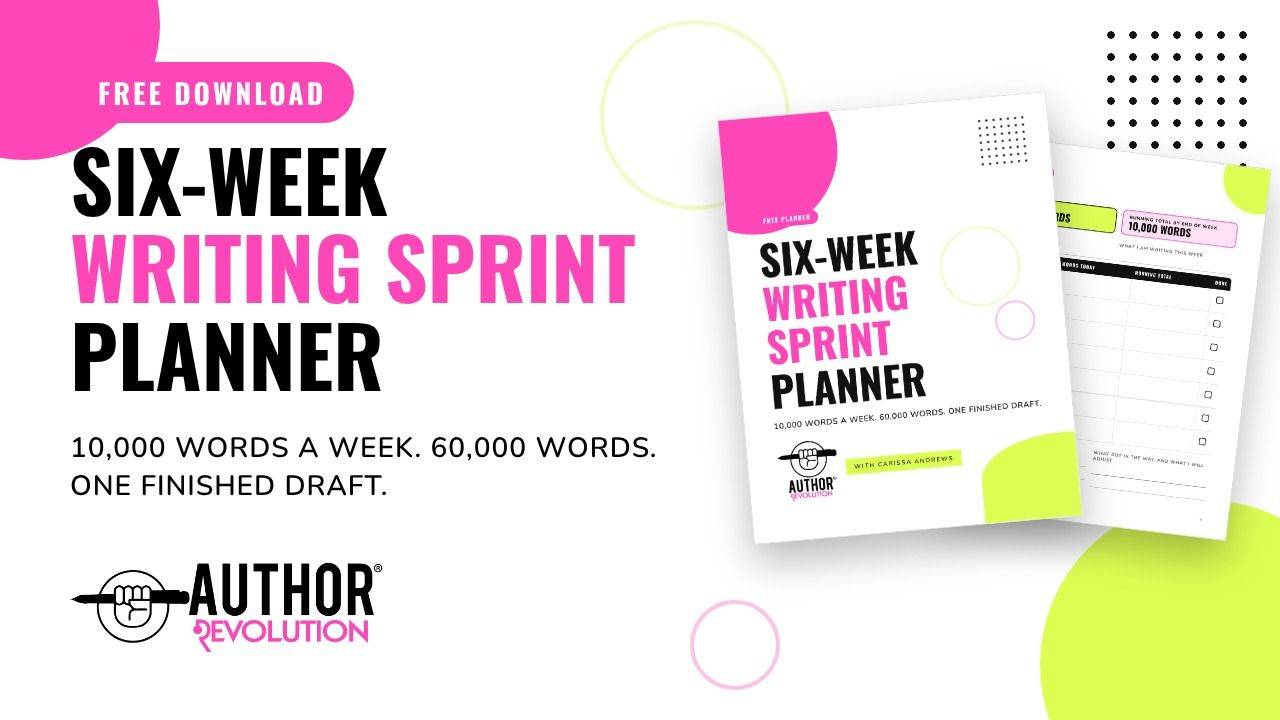
Free download
Six-week writing sprint planner
A printable planner for the six-week sprint I teach: about 10,000 words a week toward a 60,000-word first draft.
- Set up your book, your dates and your writing days
- A page for each of the six weeks, with a daily word log
- A finish-line page for what worked and what's next
It lives in your dashboard, so you can print a fresh copy for every book.
Keep learning how I teach
Short, practical posts on planning a series, finding a pace you can keep, and getting your books found.
- Oct 21, 2026How Many Books Should an Indie Author Publish a Year?Argues there's no single right publishing pace. It offers a five-step calculation for finding a sustainable schedule.Read the post
- Oct 14, 2026NaNoWriMo Is Gone: Your Best Options for November 2026Explains that NaNoWriMo closed in 2025 and lists current November writing challenges. It recommends a six-week sprint as an alternative to a one-month word-count goal.Read the post
- Oct 07, 2026Why Indie Authors Are Hard to Discover (and It's Not Your Fault)Attributes declining discoverability largely to platform algorithms outside authors' control. It suggests building owned channels, making series easy to find through search, and keeping a sustainable pace.Read the post